Tuesday, July 6, 2010

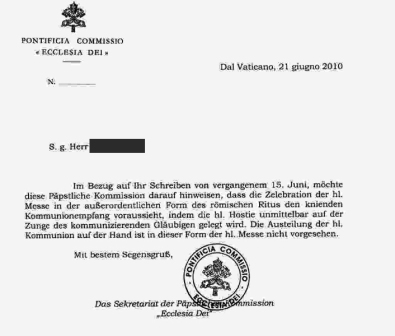
Ecclesia Dei: "no provision for the distribution of Holy Communion in the hand in this form of the Holy Mass"

By Brian Kopp

From Kreuz.net:


Translation:

Dear Mr. XXXX

In reference to your letter of 15. June, this papal commission would like to point out that the celebration of Holy Mass in the extraordinary form envisages the reception of Holy Communion while kneeling, as the Holy Host is laid directly on the tongue of the communicant. There is no provision for the distribution of Holy Communion on the hand in this form of the Holy Mass.

With blessings,


UPDATE:
WDTPRS has weighed in:

6 July 2010

Pont. Comm. “Ecclesia Dei” letter about Communion in the hand

CATEGORY: SESSIUNCULA — Fr. John Zuhlsdorf @ 12:43 pm

Even yesterday I had a conversation about the thorny issue of just what Summorum Pontificum (the 3rd anniversary of its release is tomorrow, blessed day) might have revived.

Take the situation of the distribution of Holy Communion.

In the old days before the conciliar reform of the liturgy it was unthinkable – unless you were a heretic or Protestant – that people would receive Communion in the hand. There was no need for specific decrees about such a normal practice as reception of Communion, which was always given on the tongue to people who knelt if they could.

Today, however, there is (sadly) legislation which permits Communion in the hand under some circumstances.

Summorum Pontificum did not revive the old decrees of the long-gone Sacred Congregation of Rites or automatically resurrect the practices of yore.

Or did it?

I have always held that priests need to respect the laws in force about Communion today, even in the celebration of Holy Mass in the older form. Of course they can also do all they might to discourage Communion in the hand and promote a more reverent manner of reception. At the same time, it is unlikely that many who go to the older Mass will want to receive Communion in the hand.

I received from a friend in England the following very interesting news. This is on kreutz.net.

The Pontifical Commission "Ecclesia Dei" – remember them? – sent a response to a person making an inquiry about reception of Communion at the older, Extraordinary Form. Translation:

"Dear Mr. XXXX In reference to your letter of 15. June, this papal commission would like to point out that the celebration of Holy Mass in the extraordinary form envisages the reception of Holy Communion while kneeling, as the Holy Host is laid directly on the tongue of the communicant. There is no provision for the distribution of Holy Communion on the hand in this form of the Holy Mass. With blessings,"


I note from the graphic that there was no Protocol.

There is a stamp on the letter rather than a signature.

This is a form letter.

It is therefore more than a curiosity, but it is a great deal less than the final word.

We are still left with questions about Communion during the Extraordinary Form.

If people insist on receiving in the hand, are they to be denied based on the argument that in 1962 there was no permission to receive in the hand?

And on an additional note, keep in mind this and this.
• • • • • •


Friday, June 11, 2010

Vatican official: "The new Mass is a passing phase. In 50 years, that will be entirely clear."

By Brian Kopp

In the May 2010 issue of Inside The Vatican magazine, in an article entitled "The Return of the Latin Mass," Dr. Robert Moynihan discusses the first "old Latin Mass" celebrated at the Basilica of the National Shrine of the Immaculate Conception in 40 years. The Traditional Latin Mass commemorating the fifth anniversary of Pope Benedict XVI's installation was held on April 24, 2010, and the Basilica, the largest Catholic church in America, was filled to standing room only, with nearly 4000 in attendance.

His article is well worth reading.

It appears that the future of the normative liturgy of Roman Catholicism is still in doubt, with an ongoing debate over which liturgy will emerge on the horizon, a hybrid liturgy between the Traditional Latin Mass and the Novus Ordo liturgy or a resurgence of the Traditional Latin Mass which will replace the Novus Ordo over the next several generations.

Here are a few excerpts worth considering.

A Passing Phase?

It is right that the controversy over the celebrant, Cardinal Castrillion-Hoyos vs. Bishop Slattery, did not "upstage" what was happening at this Mass.

For, in addition to the sacred mystery of the Mass itself (which was the most important thing of all, of course), something else of considerable importance was occurring on April 24 in Washington - of importance for the future of the Church, and so also of importance for the future of the West.

That "something" is this: the interest in this Mass - which was televised nationwide by EWTN - reveals that, in the West, in the United States, and precisely in Washington, DC, the capital of the US, despite a generation or more of "post-Christian" cultural pressure, there remains a desire, a hunger, to be connected with the Christian past, and to hand on to posterity what was handed down over the centuries, often in the face of much suffering.

In short, the celebration of this Mass, after 40 years and in the midst of an admittedly profound crisis in the Church, suggests that American Catholics, like their counterparts in Europe and around the world, may yet turn to the riches and treasures of their tradition to find a way forward.

And this will not be pure archaism.

It will not reflect a flight from present reality.

Nor will it be a rejection tout court of everything that came with the Second Vatican Council.

Rather, it will be an attempt to pick up the threads of our past and see if they may still be woven into the fabric of our present, in order to create the tapestry of our future.

It is our future that it looks toward - not just our past.

Having just been in Rome, having been present at the papal liturgies during Holy Week, having talked recently with a number of Vatican officials about liturgical matters and about the Second Vatican Council and its legacy, for me this liturgy reflected what Pope Benedict XVI is trying ceaselessly to teach: that the Catholic tradition has not been lost, that it remains to be discovered and lived.

How this will all work out, or course, is yet to be seen.

At least one Vatican official I talked to recently told me he believes the future of the Church's liturgical life will be a type of fusion between the old Mass and the new Mass of Paul VI.

This is the view of many.

But at least one Vatican official I talked to, also in the past month, told me he believes the future is solely and exclusively in a return to the old rite.

"The old rite is our past, and it will be our future, " he told me. "The new Mass is a passing phase. In 50 years, that will be entirely clear." (emphasis added.)

Dr. Moynihan concludes the article with an astute observation regarding Summorum Pontificum and the Orthodox:

And so the liturgy is of central importance to Benedict, and to the Vatican, today.

Benedict and his inner circle see the liturgy as critical to the future of Roman Catholicism. But not only to Roman Catholicism. There is another reason for Benedict's focus on the liturgy.

The Orthodox Connection

It is well known that the Orthodox, in a profound way, share Benedict's conviction that the liturgy is fundamental for faith, and so also for the practice of the faith.

For example, Eastern Orthodoxy's Patriarch Bartholomew I of Constantinople quoted the phrase "lex orandi, lex credendi" in Latin on the occasion of the visit of Pope Benedict XVI to Istanbul in 2006, drawing from the phrase the lesson that, "in liturgy we are reminded of the need to reach unity in faith as well as in prayer."

I believe that Pope Benedict's approval, a few months after that November 2006 visit, on July 7, 2007, of wider use of the old Latin Mass in the Latin rite, was intended to help prepare the reunion of the two great divided branches of Christianity, Catholicism and Orthodoxy.

The path to this reunion must pass, in some essential way, through the liturgy.

Through a shared liturgy. The liturgies of the two Churches must express the same faith if the Churches are ever to be once again in unity - something Christ willed for his disciples in his prayer on the final night with them before his crucifixion.


Inside the Vatican magazine is an excellent publication, by the way. Please consider subscribing.

For more on Summorum Pontificum and the Orthodox, see this previous post:

Summorum Pontificum and reunion with the Eastern Orthodox

Wednesday, June 9, 2010

'For now, the Pope will not celebrate previous rites'

By Brian Kopp

Why?

From ROME REPORTS® TV News Agency:

The Liturgy of Benedict XVI according to Guido Marini, his Master of Ceremonies

June 8, 2010. Italian Monsignor Guido Marini is 45 years old and has been Papal Master of Ceremonies since October of 2007. It is a delicate job keeping in mind that the careful attention to liturgy one of the core elements of Benedict XVI's pontificate.

Mons. Guido Marini
Master of Ceremonies Benedict XVI

“I think the pope's attention to the liturgy, his lessons in this environment and his example, help many priests and many Catholics to rediscover the central value of the liturgy for the life of the Church and for the life of each person.”

According to the Papal Master of Ceremonies, the liturgy is not an area only reserved for experts. But he notes that Catholics need help to understand the full meaning of the liturgical symbols and gestures.

Mons. Guido Marini
Master of Ceremonies Benedict XVI

“The liturgy has a popular dimension that should be preserved because through the liturgy we find ourselves with the mystery of God. There the mystery of salvation it is made real for the life of each person. So it is important to prepare people so they can read the gestures and symbols of the liturgy.”

In recent years, Benedict XVI has brought back some traditional liturgical elements that were rarely used. For example, the presence of the crucifix in the center of the altar or the receiving communion on the knees. They are gestures the pope has explained as the so-called “hermeneutic of continuity.”

Mons. Guido Marini
Master of Ceremonies Benedict XVI

“The hermeneutics of continuity highlights that in the life of the Church there is an authentic growth in the way in which they don't cut the roots so that this development includes the richness of its history and tradition.”

He says that for now it is not expected that the pope will celebrate a mass according to rites prior to the Second Vatican Council.

Monsignor Marini regularly receives instructions from the pope, but the office of liturgical ceremonies also proposes elements
for each celebration.

Mons. Guido Marini
Master of Ceremonies Benedict XVI

“In addition to putting into practice the instructions of the pope, we suggest some liturgical elements. He decides whether to accept them or not. It's to say, in every ceremony there are instructions from the Holy Father and suggestions presented by our department.”

In any case, since the pope has written many works on the liturgy, from his time as a cardinal, for the Office for the Liturgical Celebrations, it is very easy to know what the pope expects of every celebration. In other words, that the celebration helps draw people closer to the mystery of God.

JMB/IS
DC
– WP


Thursday, September 24, 2009

The Hermeneutic of Fatima

By Brian Kopp

As a follow up to yesterday's post, please note this interesting development:

News Briefs

Pope to visit Fatima next year?
September 24, 2009

Government officials in Portugal report that Pope Benedict XVI plans to visit the shrine of Our Lady of Fatima next year. The report indicates that the Pope will make the trip in May, to preside at celebrations for the feast of Our Lady of Fatima, May 13. The Vatican-- which ordinarily does not confirm a papal trip until a few weeks before it takes place-- has not commented on the reports.
Pope John Paul II traveled to Fatima on three occasions during his pontificate, making his final trip in 2000 to preside at the beatification of Blessed Jacinta and Franscisco Marto, two of the three children to whom the Blessed Virgin appeared there. (The third Fatima seer, Sister Lucia Santos, died in 2005; a cause for her beatification was opened in 2008, after Pope Benedict waived the rule requiring a 5-year waiting period.) Pope John Paul had a special devotion to Our Lady of Fatima, crediting her with saving his life when he was shot in St. Peter's Square on her feast day: May 13, 1981.
Source(s): these links will take you to other sites, in a new window.


Wednesday, September 23, 2009

Summorum Pontificum and reunion with the Eastern Orthodox

By Brian Kopp

A tantalizing headline is making its rounds in Catholic news circles: Is Catholic-Orthodox Unity in Sight?

In his Inside the Vatican Newsflash Letter #29 today, Dr. Robert Moynihan examines the implications of recent meetings between Rome and a representative of the Orthodox Patriarch of Moscow:

A fourth consideration is the relationship of the Roman Catholic Church to the world's Orthodox Churches.

It became clear last week, during a very cordial visit to Rome by a representative of the Orthodox Patriarch of Moscow, that relations between Catholicism and Orthodoxy, especially Russian Orthodoxy, at least on the surface, are much improved over the past few years.

Here are excerpts from an account of that visit I wrote for the Monday, September 21 edition of the Zenit news agency:
Recent Meeting Could Mark Turning Point

.On September 18, inside Castel Gandolfo, the Pope's summer palace about 30 miles outside Rome, a Russian Orthodox Archbishop named Hilarion Alfeyev (photo), 43 (a scholar, theologian, expert on the liturgy, composer and lover of music), met with Benedict XVI, 82 (also a scholar, theologian, expert on the liturgy and lover of music), for almost two hours, according to informed sources.

(There are as yet no "official" sources about this meeting -- the Holy See has still not released an official communiqué.)

The silence suggests that what transpired was important -- perhaps so important that the Holy See thinks it isn't yet prudent to reveal publicly what was discussed.

But there are numerous "signs" that the meeting was remarkably harmonious...

In memory of the visit, Archbishop Hilarion gave the Pope a pectoral cross, made in workshops of Russian Orthodox Church...

It is especially significant, in this context, that Hilarion, Patriarch Kirill's "Foreign Minister," has some of the same deep interests as Benedict XVI: the liturgy, and music.

"As a 15-year-old boy I first entered the sanctuary of the Lord, the Holy of Holies of the Orthodox Church,” Hilarion once wrote about the Orthodox liturgy. “But it was only after my entrance into the altar that the 'theourgia,' the mystery, and 'feast of faith' began, which continues to this very day.

"After my ordination, I saw my destiny and main calling in serving the Divine Liturgy. Indeed, everything else, such as sermons, pastoral care and theological scholarship were centered around the main focal point of my life -- the liturgy."

These words seem to echo the feelings and experiences of Benedict XVI, who has written that the liturgies of Holy Saturday and Easter Sunday in Bavaria when he was a child were formative for his entire being, and that his writing on the liturgy (one of his books is entitled "Feast of Faith") is the most important to him of all his scholarly endeavors.

"Orthodox divine services are a priceless treasure that we must carefully guard," Hilarion has written. "I have had the opportunity to be present at both Protestant and Catholic services, which were, with rare exceptions, quite disappointing… Since the liturgical reforms of the Second Vatican Council, services in some Catholic churches have become little different from Protestant ones."

Again, these words of Hilarion seem to echo Benedict XVI's own concerns. The Pope has made it clear that he wishes to reform the Catholic Church's liturgy, and preserve what was contained in the old liturgy and now risks being lost.

Hilarion has cited the Orthodox St. John of Kronstadt approvingly. St. John of Kronstadt wrote: "The Church and its divine services are an embodiment and realization of everything in Christianity... It is the divine wisdom, accessible to simple, loving hearts."

These words echo words written by Cardinal Ratzinger, now Benedict XVI, who often said that the liturgy is a "school" for the simple Christian, imparting the deep truths of the faith even to the unlearned through its prayers, gestures and hymns.

Hilarion in recent years has become known for his musical compositions, especially for Christmas and for Good Friday, celebrating the birth and the Passion of Jesus Christ. These works have been performed in Moscow and in the West, in Rome in March 2007 and in Washington DC in December 2007.

Closer relations between Rome and Moscow, then, could have profound implications also for the cultural and liturgical life of the Church in the West. There could be a renewal of Christian art and culture, as well as of faith...

(Here is a link to the complete article: http://www.zenit.org/article-26932?l=english.)


At a superficial level, there would seem to be no relation between Vatican efforts at fostering closer unity with the Eastern Orthodox, and the subject of the rest of the Inside the Vatican Newsflash Letter #29, i.e., the impending "Perfect Storm" regarding negotiations between the Vatican and the SSPX.

However, this would be an opportune moment to review a column published more than a year ahead of Summorum Pontificum:

June 29, 2006

By Brian Mershon

"Similarly, it must not be forgotten that from the beginning the Churches of the East have had a treasury from which the Western Church has drawn extensively in liturgical practice, spiritual tradition, and law"
Unitatis Redintegratio, November 21, 1964.

Is it truly feasible that the "freeing of the classical Roman rite of liturgy" is a small part of the Pope's overall plan for paving the way for the reuniting of the Latin Church with the separated Churches of the East?

Bishop Fernando Rifan, who heads up the Apostolic Administration of St. John Mary Vianney in Campos, Brazil, said he believed a further liberalization of the liturgical rite of Pope St. Pius V would aid ecumenical relations with the East.

"I really think that the Traditional Latin Mass widely and freely available would be, among many other good reasons, a great benefit in the field of the true ecumenism with the Orthodox," he said. "This would be primarily because the Traditional Liturgy is much more similar to the Oriental [Eastern] rites in the aspect of the sacred, veneration, and beauty."

Bishop Rifan and his priestly society achieved full canonical recognition and regularization with the Church on January 18, 2002.

It is hoped by many traditionalists and the Holy See that the positive example of this group of priests, which offers all the sacraments exclusively according to the ancient rites, will serve as a model for other traditionalist priestly societies such as the Society of St. Pius X (SSPX), to potentially reach full regularization with the Church.

Archbishop Raymond Burke, a notably obedient son of the Church, particularly with applying Pope John Paul II's request in Ecclesia Dei Adflicta to be "wide and generous" in allowing the Classical Roman liturgy for those Catholics who desire it, agrees with Bishop Rifan's assessment, but with a nuance.

"I wouldn't think that the Holy Father would be doing this simply as a strategy [for ecumenical relations with the Orthodox], but I do think it will be an effect of a restoration or in the 'reform of the reform' of the liturgy," Archbishop Burke said.

"It seems to me for the Eastern rites, and for those of the Orthodox Churches, the reform of the liturgy after the council and the concrete expression is so stripped of the transcendent, of the sacral elements, it is difficult for them to recognize its relationship with their Eucharistic Liturgies," he said.

Archbishop Burke agreed that the Eastern Churches would most likely identify more readily with the Classical Roman rite of liturgy, and its similarities with their own Divine Liturgies, than the Novus Ordo liturgy.

"It would be easier for them to see the unity, the oneness in the Eucharistic Sacrifice, by a rite of the Mass, just limiting ourselves now to talking about the Holy Mass, that it was richer in those dimensions — the elements of the transcendent — the symbols of the transcendent element of Christ — Christ in action in the Mass — the unbloody renewal of the Sacrifice of Calvary," Archbishop Burke said.

Not A Hopeful Indicator

Dr. Alcuin Reid, author of numerous scholarly books on the Sacred Liturgy and its history, is the recent author of Organic Development of the Liturgy, which contains glowing praise in its preface written by Joseph Cardinal Ratzinger. He affirmed that it was his opinion as a liturgical scholar, that the Novus Ordo liturgy, as practiced in the vast majority of Catholic churches, is not a hopeful indicator of eventual reunion with the East.

"I suspect that our current liturgical state does not exactly inspire confidence in them," Dr. Reid said. "The Holy Father is, no doubt, aware of this, and most probably hopes to give a sign that Rome wishes to set her liturgy in order once again, and that indeed Rome respects legitimate traditional liturgical rites."

Fr. Richard Jano is the pastor at Nativity Ukrainian Catholic Church in Springfield, Ore., an Eastern rite Catholic Church in full communion with the Holy See. As an Eastern rite priest, he has occasionally offered the Novus Ordo liturgy for area churches over the past 25 years, and he agrees with Dr. Reid's assessment.

"I think there would be some value in doing this [freeing the Classical Roman rite] as an indication of the respect the Church holds for liturgical worship that comes down to us from ancient times, and emphasizes the awe, reverence, and respectfully loving attitude that a Christian should carry into the Sacred Liturgy," he said.

"It would also illustrate the truth that the Church honors the genuine and authentic diversity of liturgies, not only in the Eastern Churches, both Catholic and Orthodox, but even within the Roman Church itself," Fr. Jano said.

...

Perhaps the better question is: "What is the common basis of doctrinal and moral issues for dialogue with increasingly more estranged, and increasingly less Christian sects with no valid priesthood?"

Pope Benedict XVI, able to tell "the tree by its fruits," clearly recognizes the advantage of having more than 500 priests in the SSPX in full communion. He also recognizes the accelerating number of priestly vocations produced in other traditionalist communities like the FSSP and the ICKSP. The current Pope's brand of "ecumenism" is one of Christian charity and justice, and perhaps recognizing "the signs of the times" called for so often in the documents of the Second Vatican Council and its aftermath by progressives.

He also understands that a united Church, East and West, may possibly be able to save Christianity in Europe and aid in re-establishing a more Christian worldview.

How does a gesture such as freeing the Classical Roman rite of liturgy fit into prospective ecumenical relations with the Orthodox, which was the primary group emphasized in the Second Vatican Council's Decree on Ecumenism, Unitatis Redintegratio?

If the Church has abandoned (or even given the appearance of abandoning in many quarters) its own liturgical patrimony and traditional devotional traditions, how can it hope to achieve any measurable ecumenical gains with the Churches of the East?

...

Cheevers said that Orthodox liturgists have always tended to cringe at the post-Vatican II liturgical reforms of the Latin Church. "Organic development in liturgy is permissible. Radical invention is not."

"The Pauline liturgy implicitly seems to move away from the clear expressions of faith about the sacramental nature of the Divine Liturgy commonly understood in the undivided church of the first millennium."

Cheevers said that a restoration of the Classical Roman rite, or so-called Tridentine rite, in the Catholic Church would probably be helpful to fostering ecumenism with the Orthodox. "It's something that Orthodox can look at and say 'we recognize this.'"

...

One of the recurring themes of Pope Benedict's writings on the recovery of the sacred in the liturgy is the positioning of the priest "toward the East" or "toward God." As an Eastern rite priest who offers all Divine Liturgies toward the East, leading his flock in worship to the heavenly Father, Fr. Jano voiced his impressions on his offering Mass "toward the people" when occasionally offering the Novus Ordo.

"On the few occasions when I have served the Mass in Roman Catholic parishes, I have been very surprised to discover how uncomfortable I am with praying to God while facing the congregation," he said. "Probably the most jarring example for me, to illustrate this point, is when I have seen Roman priests reading a prayer at Mass and gazing intently at the congregation while uttering the prayer. I've never understood this," Fr. Jano said.

"If you have something important to say to your Father, why would you stare at your brother when you're speaking to Him?"

Salutary Effects

Fr. Thomas Kocik of Somerset, Mass., and author of Ignatius Press' Reform of the Reform?, agreed that the reformed Novus Ordo liturgy is not an ecumenical breakthrough with the Orthodox.

"The Orthodox are justly disturbed not only by abuses in the post-Vatican II liturgy, but also by approved practices such as female altar servers, Mass 'facing the people' and Communion in the hand," he said. "Given the East's intense conservatism, I think the freeing of the Tridentine liturgy bodes well ecumenically, because these problematic practices are simply not standard features of the Classical Roman rite."

"The Orthodox may interpret this as evidence of a renewed seriousness in the Roman Church about the ancient maxim, 'lex orandi, lex credendi,' meaning that as we believe so we pray, and vice versa," he said. "Doctrine and worship influence each other."

...

© Brian Mershon


(See also Fr. Zuhlsdorf's 8/29/2007 WDTPRS post, Moscow Patriarch in favor of Motu Proprio and older Mass. A counterpoint to the thesis that Summorum Pontificum may have represented, at least in part, an ecumenical gesture towards the Eastern Orthodox can be found in an 11/14/2006 Vivificat blog post, The prospects of the Tridentine Mass in the light of the impending new indult.)

The developments in Vatican relations with both the SSPX and the Eastern Orthodox may best be understood neither through a "Hermeneutic of Continuity" nor a "Hermeneutic of Rupture," but through a Hermeneutic of Fatima:


If you were the pope, in the twilight of your career, a true son of VII, yet you could see the severe problems that have wracked the Church since VII, what would you do? If you had a deep seated fear that the Church would continue its moral decline if nothing is done, what would you do? If you truly believed the actions of the Vatican regarding Fatima were, at the time, honest and forthright, but now you had a real doubt that all was not as it seemed then, what would you do?

You would look at the most important aspects of the Message of Fatima that may not have been addressed, and you would systematically work to undo the damage.

1) Restore the TLM.

2) Propose a reconsideration and reinterpretation of VII.

3) Figure out a way to bring Russia back into the fold.

How?

1) Summorum Pontificum

2) Lift the SSPX excommunications, and task them with addressing the problems of VII. Put them directly in contact with the CDF. Let the tail (the SSPX) wag the dog (CDF.) Then let the CDF wag the Church.

3) Make real moves towards reuniting Eastern Orthodoxy, and use the Grace of that unity to fight the errors of post-Christian western decay.


This may be the interpretive key to truly understanding the "Marshall Plan" of Pope Benedict XVI.

Friday, August 7, 2009

Archbishop Nichols Versus Cardinal Ratzinger

By Brian Kopp

According to The Tablet

Archbishop Nichol gives no shred of encouragement to those who want the Tridentine Rite to replace the newer version. Conference participants “will wholeheartedly celebrate the Mass in each of these forms”, he instructs them bluntly, adding: “The view that the ordinary form of the Mass, in itself, is in some way deficient finds no place here.” People who hold that view are “inexorably distancing themselves from the Church”, he says. There is no scope, in other words, for “Tridentine Rite” parishes that set themselves up in the spirit of being “more Catholic than thou”. Recognising the threat of such moves, Archbishop Nichols is seeking to nip a potential schism in the bud. His firm leadership in Westminster is one that other bishops in England and Wales – and elsewhere – will welcome. The Catholic Church does not need its own version of “culture wars”, and in his message the archbishop in effect declares a priest’s personal tastes or preferences to be irrelevant.


This seems to contradict the views of Pope Benedict XVI. In Revue Theologisches, Vol. 20, Feb. 1990, pgs. 103-104, then Cardinal Ratzinger stated:

The liturgical reform, in its concrete realization, has distanced itself even more from its origin. The result has not been a reanimation, but devastation. In place of the liturgy, fruit of a continual development, they have placed a fabricated liturgy. They have deserted a vital process of growth and becoming in order to substitute a fabrication.They did not want to continue the development, the organic maturing of something living through the centuries, and they replaced it, in the manner of technical production, by a fabrication, a banal product of the moment.


In the preface to the French translation of Monsignor Klaus Gamber's most famous book, Die Reform der römischen Liturgie (The Reform of the Roman Rite) then Cardinal Ratzinger stated:

What happened after the Council was altogether different: instead of a liturgy fruit of continuous development, a fabricated liturgy was put in its place. A living growing process was abandoned and the fabrication started. There was no further wish to continue the organic evolution and maturation of the living being throughout the centuries and they were replaced -- as if in a technical production -- by a fabrication, a banal product of the moment. Gamber, with the vigilance of a true visionary and with the fearlessness of a true witness, opposed this falsification and tirelessly taught us the living fullness of a true liturgy, thanks to his incredibly rich knowledge of the sources. As a man who knew and who loved history, he showed us the multiple forms of the evolution and of the path of the liturgy; as a man who saw history from the inside, he saw in this development and in the fruit of this development the intangible reflection of the eternal liturgy, which is not the object of our action, but which may marvelously continue to blossom and to ripen, if we join its mystery intimately.

Friday, July 17, 2009

The unforgiving arithmetic of pandemic

By Brian Kopp


I was privileged to author an article/interview published this week in L'Osservatore Romano's Weekly Edition in English, as part of their coverage of the G8 Summit meeting last week in Italy. (The editors wrote the four introductory paragraphs):


The unforgiving arithmetic of pandemic
©L'Osservatore Romano
15 July 2009

Dr David Fedson on aiding developing countries in the treatment of pandemic diseases

"The world situation, as the news in recent months amply demonstrates, continues to present serious problems and the "scandal' of glaring inequalities which have endured despite past efforts". These were the words of Pope Benedict XVI during the General Audience Catechesis outlining the fundamental messages of his recently released Encyclical Letter, Caritas in Veritate (see p. 11).

When viewing the current world situation from a Catholic perspective, the pursuit of social justice within all sectors is essential, as the Holy Father clearly expresses in his social Encyclical. This constitutes the task of securing both the physical and spiritual well-being of every human being.

For this to happen the support of the governmental, medical and philanthropic communities of first world nations is urgently needed. Thus a broader vision concerning the challenges facing the world's less developed areas is crucial. This view was also expressed at the recent G8 Summit.

In the spirit of this same kind of solidarity, Brian J. Kopp, DPM, spoke with David Fedson, MD, on 3 July about the current H1N1 swine flu pandemic and the prospects for equitable treatment alternatives in developing countries. Indeed, a testament to the importance of this particular issue was President Obama's participation from Italy via telephone link in the Influenza Preparedness Summit held at the National Institutes of Health on 9 July.

Dr. Fedson is a retired American physician living in France. He has long worked on the epidemiology of influenza and influenza vaccination, first as a Professor of Medicine at the University of Virginia and later as Director of Medical Affairs for Aventis Pasteur MSD. He has served on several American and World Health Organization (WHO) committees on influenza immunization, and was instrumental in establishing the Influenza Vaccine Supply (IVS) International Task Force and the Macroepidemiology of Influenza Vaccination (MIV) Study Group. He clearly knows the influenza vaccine industry from the inside. He also knows that the arithmetic for a pandemic is simple: you can only treat the victims of a pandemic if effective vaccines and medications are widely available. For 90% of the world's population, this won't be the case.

With the current swine H1N1 pandemic influenza virus, as with the H5N1 avian flu and 1918 pandemic viruses, deaths have been prominent among the 15- to 45-year old adults. These deaths have been associated with a severe immune reaction, often called a "cytokine storm." For more than five years, Fedson has been calling for urgent and sharply focused research to determine whether drugs that reduce inflammation or modify the host response the way that the body responds to infection or injury could be used to manage the pandemic. Focusing on inexpensive generic drugs that are readily available, even in developing countries, could address the inequity already being seen, and could save millions of lives in the current and in future pandemics.

Roche announced on 2 July that they would now sell their Tamiflu to third world nations at a reduced price. Is Tamiflu still a reliable treatment option?

Tamiflu resistant swine flu viruses have already been isolated in Denmark, Japan, and Hong Kong, and the virus that was isolated in Hong Kong came from a woman who had not taken Tamiflu. Knowing that seasonal H1N1 viruses are now almost completely resistant to Tamiflu, we should expect Tamiflu-resistant swine flu viruses to appear sooner or later. It's just a matter of time, and we're seeing it already. Yet if we're fortunate and this doesn't happen, we will still have problems. Current government stockpiles of Tamiflu in "have not' countries (countries that don't produce influenza vaccines) would be sufficient to treat only 1% of the people who live in these countries. Roche has said publicly that its capacity for producing courses of Tamiflu treatment is 400 million doses per year. That's it; they can't go beyond that.

Has vaccine production capacity improved in the last few years?

No, the situation has not changed a great deal. I keep going back to the arithmetic. Two years ago it was estimated that within 9 months of the emergence of the pandemic virus, all of the world's influenza vaccine companies could produce enough doses of a new pandemic vaccine to vaccinate with two doses approximately 750 million people. More recently, a report sponsored by the WHO estimated that 6 months after the emergence of a new pandemic virus, the companies could produce 860 million doses of vaccine. These numbers are similar to the number of people living in the nine countries that produce almost all of the world's seasonal influenza vaccines.

If you're talking only about the US and want to vaccinate everyone, you will need 300 million doses. If you need two doses per person, you'll need 600 million doses and you're not going to get 600 million doses right away unless you have an antigen sparing formulation. This requires adding an adjuvant, a chemical that boosts the immune response and allows companies to decrease the amount of virus in each dose. However, US regulatory authorities are concerned about the safety of adjuvanted vaccines. As long as the virus doesn't get more virulent and the case fatality rate among non vaccinated individuals remains very low, the social and political impact of the pandemic will be tolerable; although a huge number of infections will occur, 99.5% of those infected will survive. The choice between an adjuvanted or non adjuvanted vaccine will determine whether companies produce more or fewer doses of vaccine. Erring on the side of caution will mean that developing countries will have even less chance of obtaining supplies of pandemic vaccines.

Are there any plans to provide vaccines to developing countries?

Currently, there is no logistical plan for distributing supplies of pandemic vaccines to the "have not' countries that will not be able to produce them. These countries are home to approximately 88% of the world's population.

Whether the political leaders of the nine countries that produce almost all of the world's influenza vaccines will take an active role in the allocation of H1N1 vaccines supplies is an important question, at least in my view. Given the desire of political leaders never to make decisions unless they are absolutely unavoidable, they may view the H1N1 pandemic as being no more severe in its consequences for individuals than a seasonal H1N1 outbreak. Therefore, they may decide they don't need to take an active role in deciding where doses of vaccine will be distributed, at least after they have satisfied their domestic needs. Yet we must keep in mind that whatever WHO, companies and governments do for a mild H1N1 pandemic will establish the precedents for managing vaccine production, licensing and distribution for a more severe H5N1 pandemic. For me, this is the most fascinating aspect of what we are currently seeing. It is also the most unpredictable and consequently the most worrisome.

If there will be inadequate supplies of vaccines and Tamiflu, what other options are being pursued?

Since 2004 I have tried to persuade government agencies and foundations in the US and Europe as well as the WHO to convene one or more workshops that would bring together 25-30 scientists who work with animal models of influenza, sepsis and multi-organ failure. They would be asked to review the scientific rationale for using agents that modify the host response. The agents they should consider most strongly are those that are now produced as inexpensive generics and that are widely available in developing countries. Statins, fibrates and glitazones are, in my view, prime candidates. No one has been interested in this proposal.

The generic agents I talk about affect the host response, and this is something that, with the exception of the immune response, influenza virologists know little about. We must enlist the support of scientists in other fields sepsis, critical care, cardiovascular and pulmonary diseases, metabolic disorders and mitochondrial function. They must tell influenza scientists what they know about the host response to infection, and how it might be useful to them in their research.

I'm worried that the H1N1 virus could get worse, that it could develop the virulence of the 1918 pandemic virus, or possibly combine with an H5N1 avian flu virus to give us a monster virus. Each of these developments is possible. Now if they're possible, we could spend perhaps 10 to 20 million dollars and get 90% of the answers we need to determine whether these generic agents could save lives. Is it worth organizing the research in such a way that we could quickly get the answers needed to manage a global pandemic? That's the big question. Why don't we do it?

Where, then, would efforts ideally be focused in the fight against this pandemic?

The focus of all of our efforts right now must be on ways to manage the pandemic throughout the world in ways that will save lives in this and any future pandemic. This will require a focus on the host response.

Several studies have suggested that prescriptions for statins are associated with a 50% reduction in pneumonia hospitalizations and deaths. If statins prove to be effective against pneumonia, they might be similarly effective against pandemic influenza. Experimental studies in mice show that gemfibrozil and pioglitazone dramatically reduce influenza-related mortality. A 2005 study of resveratrol showed a 54% decrease in mortality in a mouse model of influenza.

The practical implications of these findings for an influenza pandemic are enormous. For example, in 2008, 29 billion doses of statins were produced worldwide, 16 billion of them as generics. If only 5% of this output had been set aside, it would have been sufficient to provide five days of treatment for 160 million people. Since treatment would probably be necessary only for those patients at risk of serious complications, multi-organ failure and death, supplies sufficient to over 2-10% of an infected population would probably be sufficient (perhaps H5N1 excepted). Gemfibrozil and pioglitazone are also produced as generics, and many of the companies that produce them are located in developing countries. As generics, these agents would be far less expensive than vaccines and antiviral agents; according to 2008 prices, five days of treatment would cost less than $1.00. Thus, stockpiles would be affordable and distribution channels could be set up in advance of a pandemic.

We don't know how any of these drugs are handled in people who are already sick. That's key. However, we have a wonderful research opportunity right now to develop multi-center trials of single dose treatment in patients with severe H1N1 influenza. We could measure drug levels and cytokine changes following treatment at different times during the course of illness. It would not be difficult to recruit several hundred people for studies like this, but no one is organized to do them. We can't afford not to do this work.

The message that needs to go out to the world is that health officials everywhere have a responsibility to find ways to manage a pandemic in all countries. This means that they don't have to explain the molecular biology of everything that's going on. Instead, they must find agents that can be used to save lives. We have enough evidence from experimental work and enough suggestions from clinical observations to suggest that we could do this by modifying the host response using inexpensive generic agents that are already being produced in developing countries. Making effective therapies widely available is the key to a global response to a pandemic, whether it is caused by the current swine H1N1 virus, an H5N1 virus or something in between.

Sadly, the arithmetic for pandemic vaccines and antivirals is unforgiving. WHO is focused on vaccines and antivirals that will only be available to people who can afford them, and that's ten percent of the world's population. Consequently, it doesn't matter that arguments for their use are scientifically well grounded; in practical terms they are pointless, in the same way that it is pointless to tell a starving man he should eat if there's no food in the kitchen. For pandemic vaccines and antiviral agents, the kitchen is empty. We should stop talking about things that people in developing countries will never have, and start talking about things they've already got.


Thursday, June 25, 2009

The Next Motu Proprio

By Brian Kopp

First, from Inside the Vatican:

[emphasis added]

Where Is the Ecclesia Dei Document?

Inside the Vatican’s Newsflash
By Robert Moynihan, reporting from Rome

[snip]

A very important document was supposed to come out last Friday, June 19.

It didn't come out Friday. Or Saturday. Or Sunday, or Monday, or Tuesday, or Wednesday, or today.

And behind this delay, there is a story.

=======================

What document am I talking about?

Not the long-awaited social encyclical!

[snip]

The Ecclesia Dei Constitution

No, I am talking about another document entirely: the one regulating the future of the Ecclesia Dei commission (the commission founded in 1988 to focus on questions related to the old Mass and to provide pastoral care for those Catholics attached to the old liturgy).

It's a very brief document, perhaps just three pages long. It is rumored to have been ready for some time. And I was told today that it was definitely scheduled last week for release on Friday, June 19.

But it hasn't come out. Why?

[snip]

But what about the Ecclesia Dei document?

According to one friend here, "Behind the pretext of changing Ecclesia Dei, and merging it into the Congregation for the Doctrine of the Faith, the Pope wants to reopen a theological dialogue concerning Vatican II."

"What do you mean?" I asked.

"The Second Vatican Council provoked an earthquake in the Church," my friend said. "The clergy, the laity, and the Vatican itself — everything was shaken. And now, 45 years later, there is only one group which wants a thorough debate on the meaning of the conciliar documents: the Society of St. Pius X. And the purpose of moving Ecclesia Dei under the CDF is to prepare the way for a thorough debate on the conciliar documents."

"So what is the problem with that?" I asked.

"Look," my friend said. "The document regulating the role of Ecclesia Dei is all written. It has three parts: 1) some technical points concerning how it will function; 2) some measures about its relationship to the CDF, within the CDF; and 3) an outline of a program for discussing Vatican II and how the Council should be interpreted in keeping with the perennial tradition of the Church."

"And?" I asked.

"That's the problem."

"What's the problem?" I asked.

"Some people don't want these questions opened up again."

============================

What is really happening here?

Benedict, knowing that the Second Vatican Council was a watershed in the history of the Church, and knowing also that the interpretation of the Council has led in some unexpected and erroneous directions, has decided to face the basic problem — the problem of the interpretation of Vatican II — by placing the Ecclesia Dei commission in the heart of the most important doctrinal office in the Church, in the CDF.

And yet, for some reason, the implementation of that decision is being delayed.

===========================

Another friend today told me he thinks the visit of the Austrian bishops to Rome last week has not been understood.

"The Austrian bishops, who are they?" my friend said. "They are Schoenborn..."

He was referring to Christoph Schoenborn, the 64-year-old cardinal archbishop of Vienna, Austria, and a former student of Joseph Ratzinger.

"It is significant that the Pope agreed to spend two days speaking with Schoenborn," my friend said. "I think there could be further developments. For example, Cardinal Levada just turned 73 on June 15. The Pope could be thinking of bringing Schoeborn back to Rome, to take Levada's place when he turns 75..."

[snip]


Combine the highlighted areas above with this post from the Catholic Church Conservation blog, a translation of an article from the French magazine Golias, and Dr. Moynihan's statements above seem more than mere conjecture:


Thursday, June 25, 2009

New Motu Proprio on the SSPX this summer?


From the paleo-left-liberal, more Tablet than the Tablet, French magazine Golias

According to our information, and on the eve of the SSPX ordinations on 27 June in Germany, the Pope wishes to write a second motu proprio in the coming months. The document to be issued this time is not only about the liturgy in Latin, but a more comprehensive reintegration of the SSPX into the Church. This will mean demanding, of course, conditions, but also by engaging the whole Church in this process. Serious!

In other words, the bishops will no longer be entitled to express in a too overt manner open reluctantance and even less to slow the return of the traditionalists. One should understand that representatives of these currents regularly complain to the Pope posed about the obstacles placed to their reinstatement by the bishops and their entourage. Until now, Rome and the Ecclesia Dei commission have been bypassing bishops without, however, in general, openly disavow their views.

Thus, in 1988, the Commission regularised very quickly and in a very caring manner the Benedictine abbey of Barroux, without informing or consulting the Archbishop of Avignon at the time, Archbishop Raymond Bouchex. More recently, Rome proceeded in the same way with respect to the Institut du Bon Pasteur, without informing the Archbishop of Bordeaux, in whose Diocese it was located. Recently, another signal was given by the Vatican when restoring a traditional parish priest in dissent with his bishop in Calvados, just so as to remind the bishops. Following this Motu proprio, a bishop considered too reluctant to welcome the fundamentalists will certainly have his knuckles rapped.

The bishops will no longer be able to express their reservations

Benedict XVI and his advisers intend to enjoy the quiet summer to advance along the path of reconciliation. After the authorisation allowing celebration according to all the old liturgical books (Motu proprio of 2007), after the lifting of the excommunication of the four schismatic bishops ordained by Archbishop Lefebvre, a new stage is opening up, more delicate however: one on divisive theological ground in particular with regard to Vatican II and the Magisterium of the recent Popes. One should know that the Pope has chosen the new secretary of the International Theological Commission, the Dominican Father Charles Morerod, precisely because of his sensitivity towards traditionalist interlocutors. In fact Morerod is the author of a doctoral thesis submitted to the faculty of theology at the University of Freiburg, Switzerland, on the master general of the Dominicans, commentator on St Thomas Aquinas, Thomas de Vio Cajetan (1469-1534) and his polemic debate with Luther.

Father Morerod for theological agreement

But Father Morerod is especially noted for his work Tradition and Christian unity. Dogma is made a condition for the possibility of ecumenism (Word and Silence, Paris, 2005), and he kicks hard against more liberal ecumenism (fron theologians such as Fries, Rahner or Tillard) in emphasizing the essential nature of a true Catholic thought, which must be truly theological and philosophical.

Hence, it accentuates the difference between Catholicism and Protestantism in a way that does not displease the most "tradi" circles. The same Father Morerod sought to comb the thought of a British Liberal Protestant, John Hick and in which work he specifically attacks the relativist spirit. Oh, this reminds us of someone else ... the choice of Father Morerod is therefore not by chance! In very concrete terms, the Ecclesia Dei commission will report to the Congregation for the Doctrine of the Faith (cf. Golias Hebdo n ° 85). There was a question at one time of whether it should be joined to the Congregation for Divine Worship, but this would be to forget that the problem is not solely or primarily liturgical. The new Motu Proprio to come, which will be prepared by the principal drafter of the Motu proprio of 2007, Monsignor Nicola Bux, professor of theology at Bari and advisor of Joseph Ratzinger will justifies the importance accorded to the doctrine of the fundamentalist controversy. The role of Don Nicola cannot be stressed enough.

The Italian prelate Nicola Bux for the new Motu Proprio

Consultor to the Congregation for the doctrine of the faith and waiting for a promotion strategy, Msgr Bux, an Italian priest of 63 years is friendly and discreet, but frighteningly conservative and accurate in his argument, being the determined and tireless craftsman not only of moving towards the integrists but of a restoration of traditional Catholicism as a whole. He drafted the 2007 Motu Proprio on the Mass in Latin. In his latest book, released last October in Italy, The Reform of Benedict XVI, prefaced by Vittorio Messori, Msgr Bux said that rebuilding the essence of the "sacred and divine liturgy”, will not be done with the hands of humanity. Otherwise, it "would serve no purpose other than to represent himself and specifially it does not save the man or the world, it does not sanctify it." He is convinced that the Liturgy of Saint Pius V honours to a greater degree the sense of the sacred than that of Pope Paul VI. He criticizes also quite fiercely the reform named after the Montini, a true "decomposition" of the liturgy according to him, and exacerbating what the theologian Louis Bouyer called the "decomposition of Catholicism."

Indeed, Msgr Bux is not confined solely to the liturgical domain. He denounced the opening to the world that defiles the Christian mystery and censures the relaxed life of priests in particular with regard to private life (célibat. ..). He is also against the fundamental deviance according to him of contemporary theology, which uses an "anthropological turn" (which he also denounced, following Cornelio Fabro, in Karl Rahner). He counter-poses a new turning towards the theocentric and Christocentric as symbolized by the celebration back to the East, his back turned to the faithful. It is easy to imagine the content and tone of the Motu Proprio of the near future with such a writer. Cardinal William Levada, Prefect of the Congregation of the Doctrine of the Faith, who besides health problems is distressed, frustrated and demoralized, no longer has the power to oppose such an ultra-conservative regression. Far from appearing as a defence of the Council, the Motu Proprio will propose a minimalist reading, erasing the new and challenging spirit. In sum, a council "in the spirit of tradition" as Archbishop Lefebvre recognized can be accepted! Is this still the Council whose importance Paul VI proclaimed in 1976 in the face of traditionalist dissent? Nothing is less certain.


Finally, from Catholic Culture earlier this month:

News Briefs

Ecclesia Dei commission to be merged with Vatican doctrinal office?
June 11, 2009

Pope Benedict XVI will soon release a motu proprio making the Ecclesia Dei commission a part of the Congregation for the Doctrine of the Faith, according to a report by Andrea Tornielli, the Vatican-watcher for the Italian daily Il Giornale. The Vatican has offered no official comment on the report.

The Ecclesia Dei commission was established by Pope John Paul II to coordinate outreach to traditionalist Catholics. With the motu proprio Summorum Pontificum, calling for broader access to the traditional Latin Mass, Pope Benedict XVI fulfilled the key liturgical demand made by traditionalists of the Society of St. Pius X (SSPX). However the SSPX remains at odds with the Vatican on theological questions, primarily involving the interpretation of Vatican II. A move to incorporate the Ecclesia Dei commission into the Vatican's top doctrinal body could facilitate the theological dialogue with the SSPX. Italian news outlets have reported that Bishop Bernard Fellay, the SSPX leader, visited the Congregation for the Doctrine of the Faith earlier this month.

Tornielli's story also reports that within a few days the Pope will name Archbishop Malcolm Ranjith, the secretary of the Congregation for Divine Worship, to become Archbishop of Colombo in his native Sri Lanka-- a move that has been rumored for months. The Il Giornale reporter says that Archbishop Ranjith's place at the Vatican will be taken by an American Dominican priest who is currently serving at the Congregation for the Doctrine of the Faith, Father Augustine DiNoia.

Source(s): these links will take you to other sites, in a new window.

Monday, May 4, 2009

Communion in the time of Swine Flu

By Brian Kopp

Fr. Z has a post of particular interest to those interested in Summorum Pontificum and the TLM:


4 May 2009

QUAERITUR: Communion in the time of Swine Flu … again

CATEGORY: "How To..." - Practical Notes, ASK FATHER Question Box — Fr. John Zuhlsdorf @ 2:26 pm

Folks… people from all over the USA are sending me copies of notices from dioceses about the provisions for Mass during the Swine Flu outbreak. Their questions tend to run along the same lines, so I will answer collectively.

All the copies of provisions have so far indicated a recommendation (at least) that Holy Communion is to be given only in the hand.

At this point, I do not think that it is unreasonable to remind people that they have the right in the USA (and most other places I believe) to receive Holy Communion in the hand if they so desire.

Keep in mind what the Holy See’s document Redemptionis Sacramentum 92 clearly states, namely:

Although each of the faithful always has the right to receive Holy Communion on the tongue, at his choice, if any communicant should wish to receive the Sacrament in the hand, in areas where the Bishops’ Conference with the recognitio of the Apostolic See has given permission, the sacred host is to be administered to him or her. However, special care should be taken to ensure that the host is consumed by the communicant in the presence of the minister, so that no one goes away carrying the Eucharistic species in his hand. If there is a risk of profanation, then Holy Communion should not be given in the hand to the faithful.
You may also receive in the hand if you so choose.

In some places/parishes someone who dislikes Communion on the tongue may try to take advantage of the situation and attempt to say that people are forbidden to receive on the tongue.

No one may be prohibited from receiving on the tongue. A lower authority (e.g., bishop, pastor) cannot amend the legislation issued by the Holy See. They can recommend, but they cannot forbid.

At the same time, people should carefully consider their circumstances and consider what is best to do in charity. Try to determine if the recommendation is reasonable and don’t freak out.

Sunday, April 5, 2009

Fruits of Summorum Pontificum - Diocese of Altoona-Johnstown PA (Part II)

By Brian Kopp


Our local newspaper, the Johnstown Tribune Democrat, published an article today about the TLM at Queen of Peace in Patton, PA. (They used two of the photos from our "Latin in Patton" blog):

April 02, 2009 01:32 pm

Patton church brings back all-Latin Mass

BY TOM LAVIS

TLAVIS@TRIBDEM.COM


The Rev. Ananias Buccicone, OSB, pastor of Queen of Peace Catholic Church, Patton, celebrates an all-Latin Mass. Queen of Peace is the only church between Pittsburgh and Harrisburg to offer the the extraordinary Mass. Submitted photo/ The Tribune-Democrat, Johnstown, Pa.


The extraordinary Mass, also known as the traditional liturgy of the Roman rite, is being reintroduced in the Altoona-Johnstown Catholic Diocese.

For the first time in more than 30 years, Queen of Peace Roman Catholic Church in Patton is providing the all-Latin Mass, the only church in the diocese to do so.

Many supporters of the traditional Tridentine Mass are convinced that it is a priceless gift that must never be forgotten.

Brian Kopp of Johnstown is proud of the love he has for the old Mass because it offers him and his family many spiritual benefits.

“After the Second Vatican Council, in the mid-1960s, the traditional Latin Mass only was permitted to be celebrated privately by priests,” Kopp said.

But in July 2007, Pope Benedict XVI set in motion an initiative allowing the traditional Latin Mass to be offered publicly. Diocesan Bishop Joseph V. Adamec gave permission to the Rev. Ananias Buccicone, OSB, to celebrate the extraordinary Mass at Queen of Peace on Sunday afternoons.

“We are the only parish between Harrisburg and Pittsburgh to offer the all-Latin Mass,” Kopp said.

“We have had people come from as far away as State College, Indiana, Johnstown, Somerset and even people from the Greensburg Diocese.”

Buccicone, who was ordained in 1993, is required to understand and speak Latin, as well as perform the precise hand movements.

“Not being born before Vatican II, I took it upon myself to learn, because I had a desire to learn the old way,” Buccicone said.

Since Pope Benedict offered the opportunity to celebrate the extraordinary Mass, many seminaries have reintroduced Latin into their curriculums.

Unlike the new or ordinary Mass, in the extraordinary Mass, priests face the altar, not the people. It appears as if the priest is turning his back to the congregation. But Buccicone said the purpose is for the priest to face God.

“The priest is facing liturgical east, facing toward God, and he is acting as the mediator between God and man,” Buccicone said. “It’s like a general leading his troops into battle.

“I don’t view it as turning my back on the people. I view it as leading the people to God and heaven.”

People are invited to attend the extraordinary Mass at 1 p.m. Sundays. On the first Sunday of the month, a high Mass is celebrated with Schola, or choir, singing and Gregorian chant.

On the other Sundays of the month, a low Mass is said, which is the more solemn Mass.

“Anyone desiring to experience the rich liturgical traditions of pre-Vatican II, this is an opportunity to do so,” Buccicone said.

He said priests must be qualified in both the Latin language and the rubrical (text) requirements to properly celebrate the extraordinary form of the Roman rite.

During the high Mass, Gregorian chant and other ancient sacred music and clouds of incense fill the church during the liturgy.

The extraordinary Mass is much different than the ordinary Mass in its silence and lack of response from the congregation.

Latin Masses have been reintroduced at Queen of Peace Roman Catholic Church, Patton. Celebrating the extraordinary Mass is the Rev. Ananias Buccicone, OSB. Submitted photo


There is no singing and the congregation does not respond to the priest vocally.

“The silence is overwhelming,” Buccicone said.

“There is much more time for mediation, and it offers an opportunity for contemplation.”

About 150 people attend the extraordinary Mass. The sanctuary has a capacity of nearly 400.

The solemn Mass, which is said completely in Latin, attracts different types of people. Older Catholics enjoy it because it is the Mass of their youth; younger people, including some with families, appreciate the silence and mystery of the Mass.

“Ironically, older people started coming out of a spirit of nostalgia, but they discovered a reverence for the deep and sacred character of the old Mass,” Kopp said.

And younger families have found that the old Mass teaches the centrality of Christ in the Catholic faith.

The focus of the old Mass is God, not man.

“The new Mass is so busy with active participation that no one has time to pray,” Kopp said. “The old Mass has a sense of mystery and awe that gives participants a time to pray silently and understand the reality of the Mass.”

Buccicone said the majority of people attending the extraordinary Masses are young and middle-aged people.

“They enjoy the solemnity of the Mass and the mysteries that are inherent in the old rite,” he said.

During Holy Communion, communicants must kneel at the rail and take Communion on their tongue.

No one is permitted to touch the host with their hands other than the priest.

The communicant also does not say “amen” after receiving the host, as is now done in the post-Vatican II era.

Instead, the priest says, “May the body and blood of our Lord, Jesus Christ, bring your soul unto everlasting life. Amen.”

Some women in the congregation have returned to the practice of wearing chapel veils, a head covering that displays reverence to the Lord and modesty.

Even the priest’s vestments and acolytes’ cassocks are in the old style.

“I have received calls from priests and convents who have offered me the old vestments that have been stored in closets,” he said. “They are beautiful with some being over 100 years old.”

Upon entering the church, the congregation has access to Latin-English missals, which display both versions.

“The Latin is on the left and English on the right, and people can follow along easily,” Kopp said.

He said the missals help people keep pace with the celebrant as he recites the Latin words. There is no need to actually learn Latin because the translation is already made for the participant.

But learning Latin pronunciation is key to the acolytes who serve the Mass.

Kopp’s 16-year-old son, Michael, said it took about three months to learn the proper Latin pronunciations verbatim.

“There are cards that we can read, but once you do it for a while it becomes natural,” Michael said.

“I would like to see a lot more churches do this because I think a lot of young people would find it gratifying. It takes people to a higher level in realizing that they are in the presence of God, and we are with him at the Mass.”